


Your shopping cart is empty!
Sweet pepper "Adige" F1
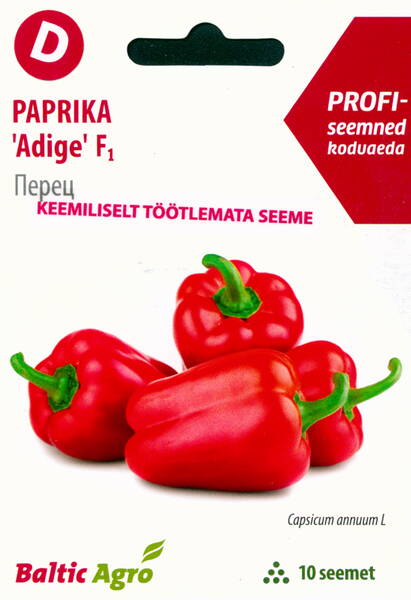

Sweet pepper "Adige" F1.
Mid-early hybrid variety for open and protected ground.
The period from planting seedlings to fruiting is 80-90 days. The fruit is cuboid, 10-12 cm long, 9-11 cm wide, wall thickness 6-8 mm.
Fruit weight up to 400 g. Colouring in biological ripeness is red. The variety is resistant to tobacco mosaic virus. Universal use.
Agricultural technology.
Loamy, breathable soils are suitable for pepper. Good predecessors are cucumber, cabbage, legumes.
Before sowing, the seeds are treated in a solution of potassium permanganate, then washed with clean water. Picking in the phase of 1-2 true leaves.
Seedlings are planted at the age of 70-80 days (when the threat of frost has passed). Landing pattern - 70x40 cm.
Watering should be done after sunset, with warm water. Top dressing should be carried out during the entire growing season.
Mid-early hybrid variety for open and protected ground.
The period from planting seedlings to fruiting is 80-90 days. The fruit is cuboid, 10-12 cm long, 9-11 cm wide, wall thickness 6-8 mm.
Fruit weight up to 400 g. Colouring in biological ripeness is red. The variety is resistant to tobacco mosaic virus. Universal use.
Agricultural technology.
Loamy, breathable soils are suitable for pepper. Good predecessors are cucumber, cabbage, legumes.
Before sowing, the seeds are treated in a solution of potassium permanganate, then washed with clean water. Picking in the phase of 1-2 true leaves.
Seedlings are planted at the age of 70-80 days (when the threat of frost has passed). Landing pattern - 70x40 cm.
Watering should be done after sunset, with warm water. Top dressing should be carried out during the entire growing season.
* Growing peppers in open ground.
Good predecessors for peppers are cabbage, root vegetables, pumpkin crops, and legumes.
Pepper plants are planted in open ground when the average daily air temperature remains stable at +13+15 °C, and there is no danger of frost returning. Planting seedlings prematurely is risky, because in cold soil the plants weaken, develop poorly, and are easily exposed to pathogens.
The planting pattern depends on the variety. Seedlings of medium-growing varieties are planted at a distance of 70 x 30-35 cm (6 plants per m2), tall and densely leafed varieties - 70 x 40-45 cm (4-5 plants per m2).
Plant seedlings in well-watered holes. The plant is placed in the hole at the same depth at which it grew in the pot; the depth is allowed no more than 1-2 cm. The roots are pressed tightly with soil. From above, around the planted seedlings, the soil must be mulched with peat to prevent the evaporation of moisture from the soil.
Plants are best planted on cloudy days or in the evening. At the same time, the plants get sick less, take root well and quickly begin to grow.
To ensure better water-air and temperature conditions on pepper plantings, soil mulching is used. Black or white polyethylene film or non-woven agrofibre is used as mulch. To do this, the bed is covered with the selected material, round holes are made through which the seedlings are planted. Pepper plants planted under mulch are faster in growth and development than plants placed on beds without mulch. In addition, when mulching there is no need to destroy weeds and loosen the soil.
Caring for plantings includes frost protection, loosening row spacing, fertilizing, watering, weed control and protection from diseases and pests. Water pepper plants at the root to avoid water getting on the leaves and flowers. After watering, the soil must be loosened, but carefully, since the root system is shallow. It is better to water with warm water. It is not recommended to water during the hottest part of the day.
For feeding, complex mineral fertilizer NPK is used, enriched with a wide range of microelements. During the growing season, fertilize the plants 2-3 times. The time for the first feeding is 10-15 days after planting in the ground. After 10-15 days, when the ovary forms on the plants, a second feeding is given. The third and, if necessary, the fourth time, the peppers are fed at the moment of mass formation and filling of fruits.
Red Pepper Lecho with Physalis.
Do you love Lecho? If so, try this original recipe for red sweet pepper Lecho with physalis and tomatoes. Physalis has natural gelling properties due to its high pectin content, making the sauce thick, rich, and delicious!
Characteristics:
Prep time: 1 hour.
Quantity: 2 liters.
Calories (per 100 g): 48 kcal (Protein: 1 g, Carbs: 10 g).
Ingredients:
- 2 kg red sweet peppers;
- 1 kg red tomatoes;
- 500 g physalis (tomatillo or cape gooseberry);
- 2 hot pepper or chili pods;
- 25 g salt;
- 40 g granulated sugar;
- Paprika (to taste).
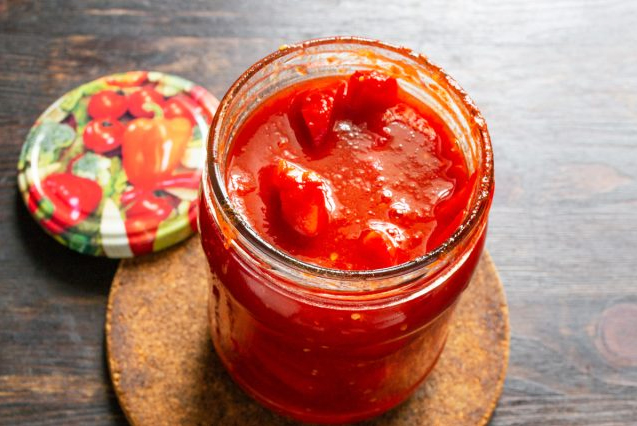
Preparation Method:
1. Base preparation: Cut ripe red tomatoes into halves or quarters. Place them in a large heavy-bottomed pot or Dutch oven.
2. Prep Physalis: Remove the papery husks from the physalis. Wash the fruits thoroughly with warm water (to remove the sticky coating). Cut into quarters and add to the tomatoes.
3. Stewing: If the vegetables aren't very juicy, add half a cup of water. Cover and simmer for about 30 minutes until the vegetables break down into a sauce. The skins should separate easily.
4. Sieving: Pass the mixture through a sieve using a spoon to extract the thick pulp and juice. Discard skins and seeds. Return the puree to the pot. (Strain again if seeds slipped through).
5. Adding peppers: Clean the sweet peppers and slice them into strips about 1 cm wide. Add to the tomato base. Add finely chopped chili for heat.
6. Cooking: Add salt, sugar, and paprika. Bring to a boil and simmer on low heat for 35-40 minutes without a lid (to allow evaporation and thickening). Optionally, add 2 tbsp of apple cider vinegar at the end.
7. Sterilizing jars: Wash jars with soda, rinse, and place in a cold oven. Heat to 100°C and dry for 10-15 minutes.
8. Canning: Pour the boiling Lecho into hot, dry jars. Seal with boiled lids.
9. Cooling: Wrap the hot jars in a towel or blanket and leave until completely cool. Store in a dark, cool place.
Tip: If storing in a warm apartment, sterilize 0.5 L jars in boiling water for 15 minutes.
Lecho with Physalis: Thick Sauce Recipe - buy in Europe